Aunt Ruth Archive

Tales of a solo traveler

Category: Austria

On top of the world

September 1, 1948 (continued)

Since Linz is the half way mark between Salzburg and Vienna, it is convenient to go to either for weekends. The last two weekends we have come to Salzburg and Berchtesgaden, where we have taken a number of tours. We got in on part of the Salzburg festival, seeing an excellent performance of the morality play Jederman (Everyman) for which the festival is famous. It was held out in the open in front of the cathedral.

At Berchtesgaden we stayed at the Berchtesdadener Hef, a magnificent hotel where the Nazi big wigs used to stay. From our window we had a breathtaking view of the Bavarian Alps. No wonder Hitler liked this part of Germany. It’s like a fairy land. The napkins used in the dining room have a swastika in the center of them and are made of beautiful linen. I had great difficulty resisting the temptation to take one!

From Berchtesgaden we took Special Services tours to the Eagle’s Nest, (Hitler’s tea room). Koenigsee (beautiful 5 mile lake nestled in the Alps), and Chiemsee, lake resort where King Ludvig II’s dream castle is located. The castle is beyond all imagination.
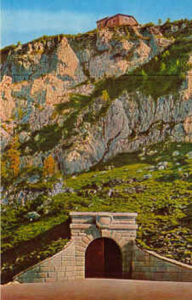
The entrance to the Eagle's Nest

The entrance to the Eagle’s Nest

The trip up 6000 feet (straight up) to Hitler’s Eagle’s Nest was particularly exciting because our jeep broke down as we were on a 90 degree angle, and we had to be towed up! We learned a few German cuss words from our native driver that day! Eagle’s Nest was well named. It is on top of a rocky crag where you feel as if you were on the top of the world. The beauty of the fairyland below and the feeling of power up there perhaps helped Hitler to decide on that spot for his tea room.* The next is reached by a 460’ elevator, a beautiful “art object” in itself. The elevator is made of gleaming brass, leather seats heated from beneath, large round mirror in the center. In the floor there is a hatch door which opens into the room where Hitler kept 2 guards and a cook.

The elevator to the Eagle's Nest.

The elevator to the Eagle’s Nest.

The Nest was completely stripped of all its appointments by the French who arrived one day before the Americans. Look down about 3000 feet you can see the ruins of Hitler’s, Berman’s, and Goerring’s homes, the SS Barracks, Gestapo Headquarters, a Nazi Hotel, guest house, etc.
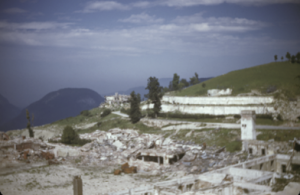
The remains of the SS Barracks

The remains of the SS Barracks

The ruins are a perfect example of precision bombing. Hitler’s house was hit exactly in the middle. Nothing is left of that Nazi Community. Looking down several thousand feet from the other side of the Nest you can see lovely Koenigsee and the Watzmann Mountains, second highest in Germany. The Nest is between 8 and 9 thousand feet above sea level and 2,000 feet above Berchtesgaden.

I feel as if I’ve written a book. You’re probably all dozing by now! I certainly wish you could be here to enjoy these things with me. One thing all of us have missed very much in the last 7 weeks is mail from home, so I hope you’ll take time out to tell me the news.

Love,

Ruth


*One point of clarification—the Eagle’s Nest was not actually Hitler’s tea room. Ruth made this point in later notes. The tea room was actually down near Hitler’s home. He apparently spent a lot of time at that home and in the tea room and there were at least three assassination attempts there. He did not spend much time in the Eagle’s Nest, despite the fact that it took 3,000 men one year to build and cost approximately $10 million dollars.

When I first started reading Ruth’s letters and diaries, I will admit I was disappointed. She comments a lot on food, on the cost of hotels or a cup of coffee (I’ve spared you many of those details). However, as I read more, I find myself sucked into her descriptions and her interpretations of the locations. While undoubtedly a gorgeous local, I think I would find the Eagle’s Nest revolting because of the person who had inhabited it; the conversations that must have occurred there. Instead, Ruth comments on the “feeling of power” on that craggy rock.

Aunt Ruth was certainly not a Nazi sympathizer. What did she feel when she was in these places, looking down on the ruins of Hitler’s house? I don’t have a good comparison–I have been to Tienanmen Square, where I just felt sadness, but that’s not really even a good comparison. And it’s really not very pretty. Perhaps the immense beauty of the Alps has reclaimed the location from the evil that lived there?

It’s also fascinating to look up the plays and movies she mentions. It turns out that the play “Jedermann” is still performed every year in the same spot, in front of the cathedral in Salzburg. I had never heard the term “morality play,” but I understand it is an allegory, exploring the conflicts between good and evil. It seems apropos for that time period, as all Europeans were forced to explore those concepts first hand as they rebuilt after the war.

That’s all for now. Next time, we follow Aunt Ruth to Big Bertha’s castle where she has a chance encounter with one of the world’s most powerful women.
 

The Red Carpet

September 1, 1948 (continued)

After 3 days of teacher’s “institute” where we were indoctrinated with army lingo, “channels,” procedures, occupation policies, etc. seven of the original 11 [teachers] boarded the Mozart [train] again, arriving in Linz, Friday, August 27 at 2 a.m.

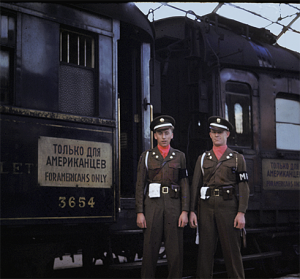
The Mozart Train. Ruth mentions this train several times in her diaries and letters.

The Mozart Train. Ruth mentions this train several times in her diaries and letters.

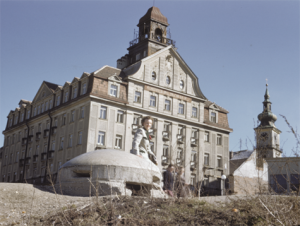
The red carpet was really rolled out for us when we arrived in Linz. A Colonel and Captain welcomed us, the Army photographer took our pictures, a corps of privates and MP’s took care of our luggage and transported us to the Linzerhof

The Linzerhof Hotel

The Linzerhof Hotel

(hotel). Awaiting us there was a delicious repast of thick ham and tomato sandwiches, coffee, and a decorated cake with “Welcome to Linz” on it. Potted plants, flowers, and cookies were in our rooms. We got “acquainted” with the Army until four A.M., getting to bed just as the city came to life.

The next day a group of Army wives took us on a tour of the country and we were received by General Loyal Haynes, who talked with us at great length, giving us the Army’s whole-hearted support for the school programs. It seems that the General is interested in making the Linz school the finest one in all of the European theater! The elementary school here has been in operation for 2 years, but the high school is new. It’s going to take a lot of work to get it organized. At first I was disappointed at leaving Vienna, but now I realize it was the best thing that could have happened. One great advantage is that we are in the American zone and can “take off” on trips whenever we please.

The school building is very modern (one of the most modern in Austria), has many large windows, and is very large. It would compare very favorably with any school in the States. We have twice as much room as we need right now so there is plenty of room to expand.

We have already been invited to two teas and have met a number of the officer’s wives. They’re a fine group of people with a great deal of Linz Community spirit. That same spirit and support and cooperation is not present in either Vienna or Salzburg at the present time so we feel very fortunate to be in Linz, even tho the city itself is not very beautiful.

This is a bit of a fluff piece; it shows that Ruth is excited about her upcoming teaching adventure. I share this part of her letter for a couple reasons:

1. It shows how much she loves to talk about food; and

2. I really like to think that term “got acquainted with the army” means something a little scandalous happened. Perhaps she imbibed? Or flirted with some army boys? My aunt was always prim and proper when I knew her—I like to think she let loose a little bit. We will never know…

I tried to find out more about the school where she taught, but sadly, other than finding the obituary of a gentleman who attended the school in 1948-49, I was unsuccessful.

Next post, I follow Aunt Ruth to the “top of the world.” Her pictures will tell the story.

What It Means to Lose a War

In August of 1948, Ruth traveled to Europe aboard the Zebulon Vance, a refurbished hospital ship. Aunt Ruth was always verbose, so I’m just taking the first part of her first letter from Austria. All photos are hers unless I note otherwise.

The Zebulon Vance. A refurbished hospital ship. Ruth wrote that the fastest speed was 12 knots--apparently the slowest troop transport. She was assigned bunk 13 in cabin C-2. There were 40 girls to a cabin with 2 showers. It took 15 days to cross the Atlantic from New York to Bremerhaven.

The Zebulon Vance. A refurbished hospital ship. Ruth wrote that the fastest speed was 12 knots–apparently the slowest troop transport. She was assigned bunk 13 in cabin C-2. There were 40 girls to a cabin with 2 showers. It took 15 days to cross the Atlantic from New York to Bremerhaven.

September 1, 1948

Linz, Austria

 Hello Everybody!

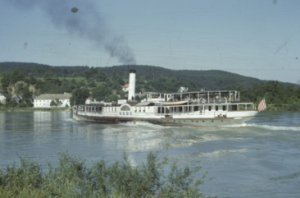
The Blue Danube

The “blue” Danube

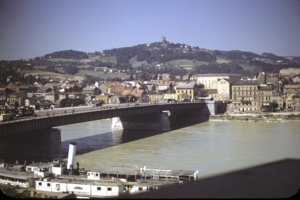
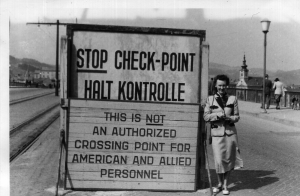
This is the first chance I’ve had to stay put in one place long enough to write a letter. Please excuse the carbon copies, but time doesn’t permit anything else. After five weeks of traveling I have finally arrived at my permanent station—Linz, Austria, an industrial town (steel, iron, salt, chemicals, textiles) of 180,000 population. We are billeted in the Linzerhof Hotel, and my window looks out over the “blue” Danube, which, incidentally, is a chalky green color. The Danube at this point marks the dividing line between the American and Russian zone and from my window I can look out on the Russian sentry at the end of the bridge.

The bridge post between the Russian and American zones.

The bridge over the Danube. You can see the checkpoint between the Russian and American zones.

The Russian section. Ruth was here right after the Berlin airlift had started in response to the Soviet blockade of rail, road and water access to Allied-occupied areas of Berlin, so tensions were high between the Russians and other Allied forces at this time.

The Russian section. Ruth was here right after the Berlin airlift had started in response to the Soviet blockade of rail, road and water access to Allied-occupied areas of Berlin, so tensions were high between the Russians and other Allied forces at this time.


 The whole trip has been most enjoyable, and I must give the Army credit for taking excellent care of us. We had expected to go to Bad Wiesse (30 miles out of Munich) for orientation with the German group of teachers, but found out as we were being processed on the ship that we were to go directly to Vienna instead.

 The “Austrian delegation” of 11 teachers was the first to leave the Vance and walk across the docks to the military train waiting there. The train was a good one, our sleeper being a French coach. The first night the generator broke so we had no lights, but fortunately I had brought a flashlight along. We also had a “Spiesewagon” (diner) on the train. Only on American military trains do you find any food or water.


The trip from Bremerhaven to Munich was very interesting and shocking. As we passed through the extensive ruins of Bremen, Frankfurt, Stuttgart, Ulm, Augsberg, Munich, we realized what it meant to lose a war. All these railroad stations and almost everything around them were completely destroyed. If you can picture the Union Station in L.A. as nothing but a few tracks, some cement runways, no roof, and a few makeshift woode

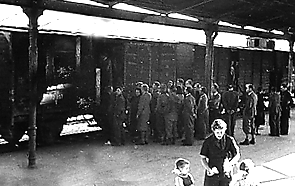
Displaced Person train. There were still hundreds of thousands of displaced persons in 1948. Most had subsisted on 1,500 calories a day.

n shacks for luggage, you will have some idea of what many of the RR stations looked like. Their German civilian trains were badly overcrowded, the people very poorly dressed, and as we would leave the trains, hundreds of cold, curious, inscrutable, staring eyes would greet us. The Germans rarely smile and they are very quiet. The noisiest people in Germany and Austria are the Americans. I often wonder what the Germans and Austrians think of the noisy laughter and uninhibited remarks that the Americans make. I overheard one American girl remark that “Vienna reeks of culture!”


So this is where I pause and try to wrap my head around WWII and the aftermath in Europe. Aunt Ruth came ashore in Bremerhaven on August 18, 1948 after 15 days at sea crossing the Atlantic. She took a train from Bremerhaven to Munich. It was three years after the end of World War II. In 2016, I am the same age as she was at that time, and I have the benefit of 70 years having passed from then. We have solidified our history books about the time.

First, something light and interesting–carbon copies! I was irrationally annoyed at these wafer thin pieces of yellow paper until I realized the dedication it must take to write a letter. First of all–this is where “cc” comes from! It’s not just the place to put the email address of someone’s boss if you want to be passive aggressive! Secondly, this was the only way to make copies, so Ruth really had to prioritize who she wrote her very long letters to! Here’s a cool piece from Mental_Floss about carbon copies in case you are interested.

Back to the post-WWII analysis. While the physical carnage of the country must have been horrifying, it’s the people I am most interested in. What was behind those “cold, curious inscrutable staring eyes?” So this is where my inquiry could go several different ways. I’m starting by looking at the American approach to the Germans, or what Ruth refers to as the “occupation policies.” She learned these in her “indoctrination classes” aboard the Vance. Summarizing her class called, “You and the Germans,” she writes:

The general policy was “courteous firmness toward all the Germans.” We must be “firm, clear sighted, analytical, not overly sympathetic, but aware of the facts.” We should “show them the way of democracy by our lives.

 I wish she would have kept some of the literature from these classes, but thus far I haven’t come across it. Here’s what I found doing some 21st century research (i.e. Google).

Initially, there was a strict non-fraternization policy for U.S. occupation troops. Photos of concentration camp victims were used as pictorial reminders. A 1944 version of a Handbook for Military Government in Germany recommended a quick restoration of normal life—I interpret that to mean that the Allied powers who occupied Germany would assist in economic reconstruction. When presented this, Franklin D. Roosevelt rejected it, saying:

Too many people here and in England hold the view that the German people as a whole are not responsible for what has taken place – that only a few Nazis are responsible. That unfortunately is not based on fact. The German people must have it driven home to them that the whole nation has been engaged in a lawless conspiracy against the decencies of modern civilization.

That military handbook was rewritten to be more consistent with the Joint Chiefs of Staff directive 1067, which stated “take no steps looking toward the economic rehabilitation of Germany or designed to maintain or strengthen the German economy.”

This approach to Germans was largely abandoned by 1947 with JCS 1779, which however it seems clears from Ruth’s description that the Army still emphasized the need to keep German civilians at arms length.

So that’s really interesting. Knowing Ruth, as I hope you all will come to do, I know that she was very principled and opinionated. I can imagine her following the directives from her army classes to the letter.

I’m new at this, so I’m going to start with questions. Maybe as I move through her journey, I will develop some conclusions.

First, did she look down upon these Germans—judging them for allowing some of the most horrendous atrocities the world has ever seen? My aunt was a very strong Christian, so the concept of forgiveness would have been an important element in her approach.

How would I have acted, knowing what I know—instead of just 3 years, having the benefit of 70 years of time passing since WWII?

What were those Germans really thinking? “Please don’t judge us—we really didn’t know.” “Why are you here? Hitler may have done some bad stuff but at least we could feed and clothe our kids.”

I’m going to head to the library to check out some books on this—Google can only do so much for me. Let me know if you have any good resource suggestions.

Thanks for trying this out. There are lots of things to think about and I’m only through half of her first letter. Next up–the “Red Carpet” was rolled out for Ruth and her colleagues when she reached Linz!

For now, bon voyage!

Powered by Root Beer Floats & Theme by Anders Norén