
September 1, 1948 (continued)
Since Linz is the half way mark between Salzburg and Vienna, it is convenient to go to either for weekends. The last two weekends we have come to Salzburg and Berchtesgaden, where we have taken a number of tours. We got in on part of the Salzburg festival, seeing an excellent performance of the morality play Jederman (Everyman) for which the festival is famous. It was held out in the open in front of the cathedral.
At Berchtesgaden we stayed at the Berchtesdadener Hef, a magnificent hotel where the Nazi big wigs used to stay. From our window we had a breathtaking view of the Bavarian Alps. No wonder Hitler liked this part of Germany. It’s like a fairy land. The napkins used in the dining room have a swastika in the center of them and are made of beautiful linen. I had great difficulty resisting the temptation to take one!
From Berchtesgaden we took Special Services tours to the Eagle’s Nest, (Hitler’s tea room). Koenigsee (beautiful 5 mile lake nestled in the Alps), and Chiemsee, lake resort where King Ludvig II’s dream castle is located. The castle is beyond all imagination.
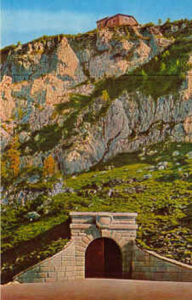
The entrance to the Eagle’s Nest
The trip up 6000 feet (straight up) to Hitler’s Eagle’s Nest was particularly exciting because our jeep broke down as we were on a 90 degree angle, and we had to be towed up! We learned a few German cuss words from our native driver that day! Eagle’s Nest was well named. It is on top of a rocky crag where you feel as if you were on the top of the world. The beauty of the fairyland below and the feeling of power up there perhaps helped Hitler to decide on that spot for his tea room.* The next is reached by a 460’ elevator, a beautiful “art object” in itself. The elevator is made of gleaming brass, leather seats heated from beneath, large round mirror in the center. In the floor there is a hatch door which opens into the room where Hitler kept 2 guards and a cook.

The elevator to the Eagle’s Nest.
The Nest was completely stripped of all its appointments by the French who arrived one day before the Americans. Look down about 3000 feet you can see the ruins of Hitler’s, Berman’s, and Goerring’s homes, the SS Barracks, Gestapo Headquarters, a Nazi Hotel, guest house, etc.
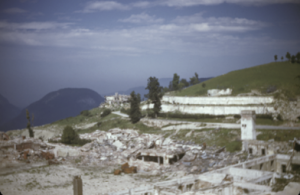
The remains of the SS Barracks
The ruins are a perfect example of precision bombing. Hitler’s house was hit exactly in the middle. Nothing is left of that Nazi Community. Looking down several thousand feet from the other side of the Nest you can see lovely Koenigsee and the Watzmann Mountains, second highest in Germany. The Nest is between 8 and 9 thousand feet above sea level and 2,000 feet above Berchtesgaden.
I feel as if I’ve written a book. You’re probably all dozing by now! I certainly wish you could be here to enjoy these things with me. One thing all of us have missed very much in the last 7 weeks is mail from home, so I hope you’ll take time out to tell me the news.
Love,
Ruth
*One point of clarification—the Eagle’s Nest was not actually Hitler’s tea room. Ruth made this point in later notes. The tea room was actually down near Hitler’s home. He apparently spent a lot of time at that home and in the tea room and there were at least three assassination attempts there. He did not spend much time in the Eagle’s Nest, despite the fact that it took 3,000 men one year to build and cost approximately $10 million dollars.
When I first started reading Ruth’s letters and diaries, I will admit I was disappointed. She comments a lot on food, on the cost of hotels or a cup of coffee (I’ve spared you many of those details). However, as I read more, I find myself sucked into her descriptions and her interpretations of the locations. While undoubtedly a gorgeous local, I think I would find the Eagle’s Nest revolting because of the person who had inhabited it; the conversations that must have occurred there. Instead, Ruth comments on the “feeling of power” on that craggy rock.
Aunt Ruth was certainly not a Nazi sympathizer. What did she feel when she was in these places, looking down on the ruins of Hitler’s house? I don’t have a good comparison–I have been to Tienanmen Square, where I just felt sadness, but that’s not really even a good comparison. And it’s really not very pretty. Perhaps the immense beauty of the Alps has reclaimed the location from the evil that lived there?
It’s also fascinating to look up the plays and movies she mentions. It turns out that the play “Jedermann” is still performed every year in the same spot, in front of the cathedral in Salzburg. I had never heard the term “morality play,” but I understand it is an allegory, exploring the conflicts between good and evil. It seems apropos for that time period, as all Europeans were forced to explore those concepts first hand as they rebuilt after the war.
That’s all for now. Next time, we follow Aunt Ruth to Big Bertha’s castle where she has a chance encounter with one of the world’s most powerful women.
Comments are closed.